 Skip to content

Scientific articles
Telogen Effluvium Acute Post-Covid

Dr. Paolo Gigli
Physician specializing in dermatology and venereology
Adjunct professor in medical and surgical trichological sciences
at the University of Florence
Founding member of the Italian Society of Trichology
Deputy Scientific Editor of the Italian Journal of Trichology
TELOGEN EFFLUVIUM
Over the years, a new therapeutic approach has been developed precisely to treat Telogen Effluvium in which severe psychophysical stress is present. Usually effluvium (both acute and chronic) presents as numerically high and qualitatively homogeneous hair loss, obviously with more hair loss in the acute and less in the chronic (as it is distributed over time).
Acute telogen effluvium
Major fall of perfectly formed hair, almost exclusively in the telogen phase, with no signs of involution. Usually occurs as a result of a stressful event that affects hair in the Anagen 6 subphase, forcing it to go into telogen. A stressful event is defined as either something psychological or an infectious disease and/or surgery. For example, post covid telogen effluvium is acute post-infectious telogen effluvium very similar to that which occurs after measles or chickenpox (hair loss after these infections is common in children, but in many cases no one notices it). Of course, we are talking about the consequences of an infection with the severe and heavy symptoms Like those in Covid-19. In these cases, the fall usually lasts for a long time and causes major emptying even in people who have never had hair problems.
Usually the trichogram is altered, with a disparity between anagens and telogens: telogens increase, of course. The wash test can reach very high values, even up to 1000 hairs, emolto often are accompanied by other symptoms such as trichodynia, scalp burning, pain.
The causes
- Acute stress
- Childbirth and breastfeeding
- Infectious and febrile diseases
- Hemorrhages
- Post-surgery
The causes
- Systemic diseases (autoimmune, infectious, neoplastic)
- Blood donations (hypoferritinemia)
- Drugs
- Mental illness and psychological disorders in general
- Dystroidisms
Patient management
The psycho-emotional element plays a decisive role in these cases, and usually telogen effluvium predominantly affects female patients who have underlying psycho-emotional alterations, states of depression, anxiety or obsessive compulsive situations.
These are patients who need to be followed carefully, they need to be comforted: they need to be reassured that telogen effluvium almost never leads to baldness, and this is a very important point, especially from the emotional and psychological aspect. However, the first advice to be given is to manage all possible events or causes that may generate acute stress or other psychological/psychological problems.
Therapy
Usually, these patients are prescribed keratoregulatory supplements and antioxidants
topical with mild corticosteroids in cycles, such as the popular hydrocortisone butyrate.
In special cases, and great care must be taken, very low percentage Minoxidil can also be used.
Lately N-acetylcysteine has established itself in the medical field for the treatment of similar pathologies, because this also acts as a kerator-regulator and goes to reorganize the tertiary structure of keratin. Soit is strongly recommended in all those situations where there is an alteration of the tertiary structure of keratin, when there is physicochemical damage to the lengths of hair induced by straightening, hair dryer and coloring. In addition, N-acetylcysteine at high dosages behaves as a glutamate-modulating agent: this substance goes to act at the level of the central nervous system and causes glutamate depletion in astrocytes close to the nucleus accumbens, making GABA (an inhibitory neurotransmitter) predominate. It could almost be said to act similarly to a psychotropic drug.
Scientific literature, in fact, claims that N-acetylcysteine dosed 1200/2400 mg/day has been used in the treatment of schizophrenia, bipolar disorders, but not only: also trichotillomania, dermatillomania, autism, compulsive gambling. All this, therefore, supports the thesis that its use for the treatment of Telogen Effluvium is absolutely recommended.
All this is possible due to the fact that N-acetylcysteine is a precursor of glutathione but, unlike the latter, it is able to cross the blood-brain barrier of the central nervous system, then is converted to glutathione and subsequently to cysteine, glycine, and glutamate. Cysteine dimerizes cystine, which is transported to astrocytes near the nucleus accumbens in exchange with glutamate.
The increase in extracellular glutamate results in an inhibition of glutaminergic (excitatory) transmission resulting in a prevalence of GABAergic (inhibitory) transmission.
In other words,it is an inhibitory effect due to this glutamate-modulating action.
In addition, glutathione modulates the release of dopamine, which acts as a mood stabilizer, as well as having an anti-inflammatory and antioxidant effect.
For this reason, a nutraceutical that also includes tryptophan (an amino acid precursor of serotonin with many clinical uses) along with N-acetylcysteine is definitely suitable for the treatment of telogen effluvium: tryptophan is converted to serotonin at the central nervous system level, so it regulates sleep, mood, and appetite. Serotonin, in turn, is a precursor of melatonin, which is directly involved in the hair cycle because it sterically inhibits Dihydrotestosterone receptors.
The above nutraceutical, in its formulation, also includes biotin and zinc. Thus, in these cases, this is the preconstituted association:
- N-acetylcysteine 600 mg
- 5-OH Tryptophan 50 mg
- Biotin 500 mcg
- Zinc 7.5 mg
This can be a good aid to combine with basic therapy against acute and chronic telogen when the patient’s psycho-emotional component is important and when we do not want to refer the patient to a psychiatrist. This is a natural therapy that allows us to go some way to modulate the psychological state of the patient and stabilize mood, acting on certain mechanisms that then intervene in the pathogenesis of telogen.
These are therapies that have to be followed for quite an extended period of time, starting from a minimum of six months. In particular, patients should be visited often and comforted: they should by no means be left to their own devices because these are people who, often, are psychologically fragile.
For more information...
Share the article on your socials!
Stay up to date*, sign up for our Newsletter to receive every article on your email!
You may also be interested in.
-
 23 Feb 2026STUDIO SU UN NUTRACEUTICO ED UNA LOZIONE FITOTERAPICA IN DONNE CON ALOPECIA FEMMINILE POST-MENOPAUSA
 -
 15 Sep 2025THE USE OF GINKGO BILOBA EXTRACT IN THE TREATMENT OF CHRONIC FATIGUE SYNDROME
 -
 04 Jul 2025ON THE USE OF SPECIFIC NUTRACEUTICALS AS ADJUNCTS TO TREATMENTS FOR ADHD
 -
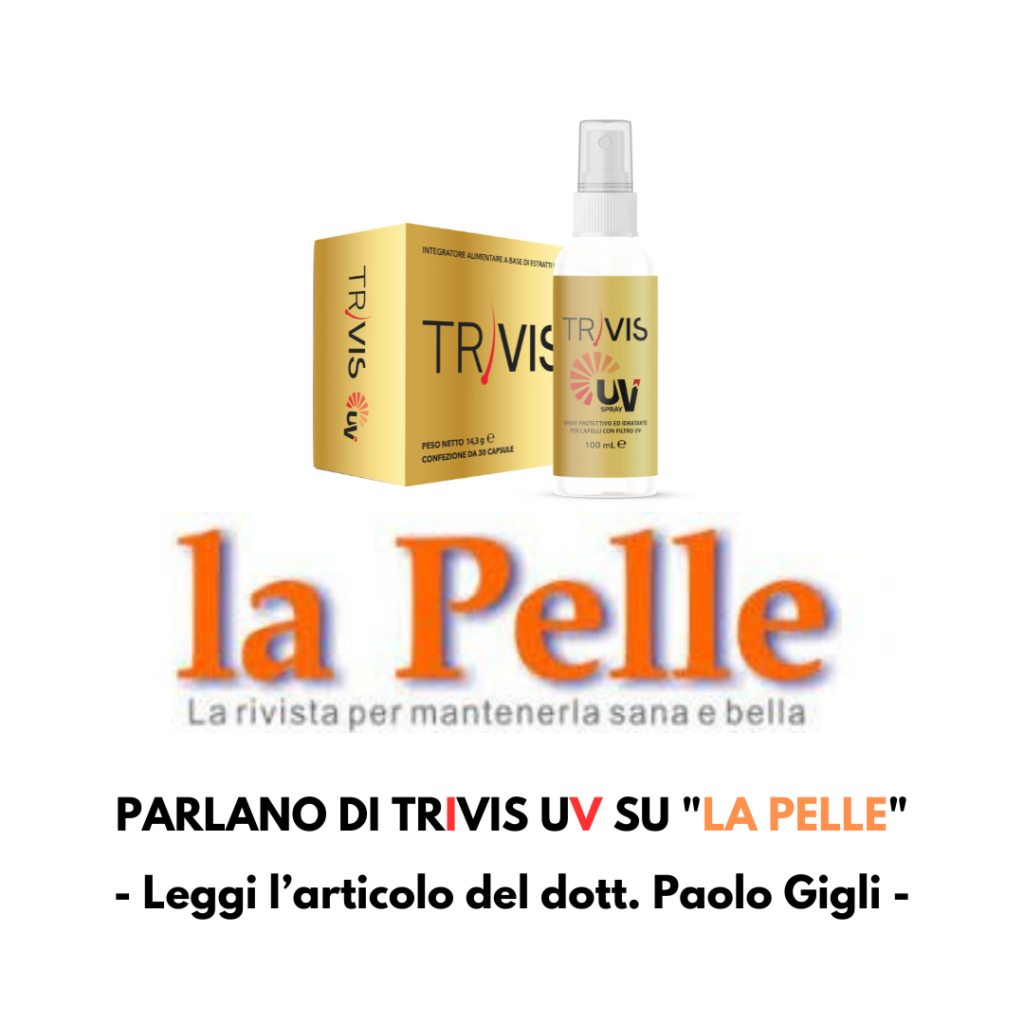 24 Jun 2025THEY TALK ABOUT TRIVIS UV ON “THE SKIN”
 -
 19 Jun 2025ON THE BENEFITS OF HYALURONIC ACID ON SCALP AND FOLLICLES


